

Self-pay payments for addiction treatment centers
Thursday's admit,
deposit already paidThursday's admit, deposit already paid
RehabSignal is admissions software for US addiction treatment centers that sends rehab payment plans, deposits and self-pay balances by text from your center's number. Whoever is paying taps the link and checks out by card or phone wallet.
- Deposit links by text
- Saved-card payment plans

Live in 14 daysMonth to month, no setup fee
- Payment links on forms
- Balances split into set monthly card charges
- Texts ahead of each payment date
- Financing links from your lender
- Card or phone wallet checkout
After Monday's screening, the admissions director held a residential bed for Thursday. The coordinator emailed an invoice to an address the parent rarely opens. Wednesday afternoon came, the bed was still held, and nobody had asked about the deposit.
Card numbers read over the phone
Sent, tapped, paid
A plain text, a link, a tap


Sending payments
Deposits, plans and financing, sent by text
Each starts from the card your coordinator works.


The coordinator types the amount your center set for residential, adds Thursday's date and taps send from the inquiry's card. The parent gets it mid-call, from your center's number.
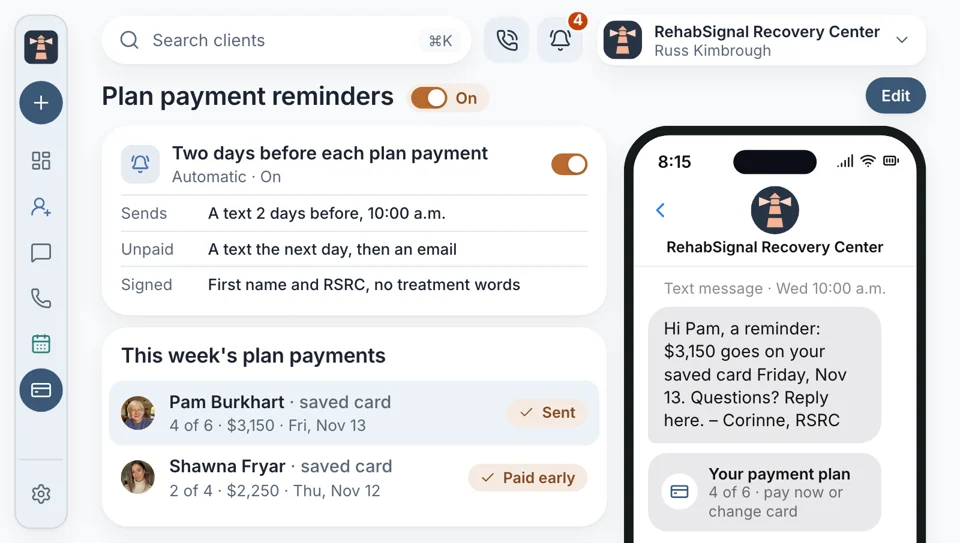
Your business office splits a self-pay balance into set payments, and the invoice lists each date and amount. The person paying saves a card once, and each payment is charged on its date.
Some self-pay families ask about financing before they commit to a stay. We add your lender's link to your text templates, your invoices and your site's self-pay page, and the family completes the lender's application on its site.
How payments fit your day
Payments beside your calls, ads and reviews
A deposit comes up on the screening call, the reminder is a text, and a refund question can turn up in a Google review months later. Each of those parts works with payments.
Owner dashboard
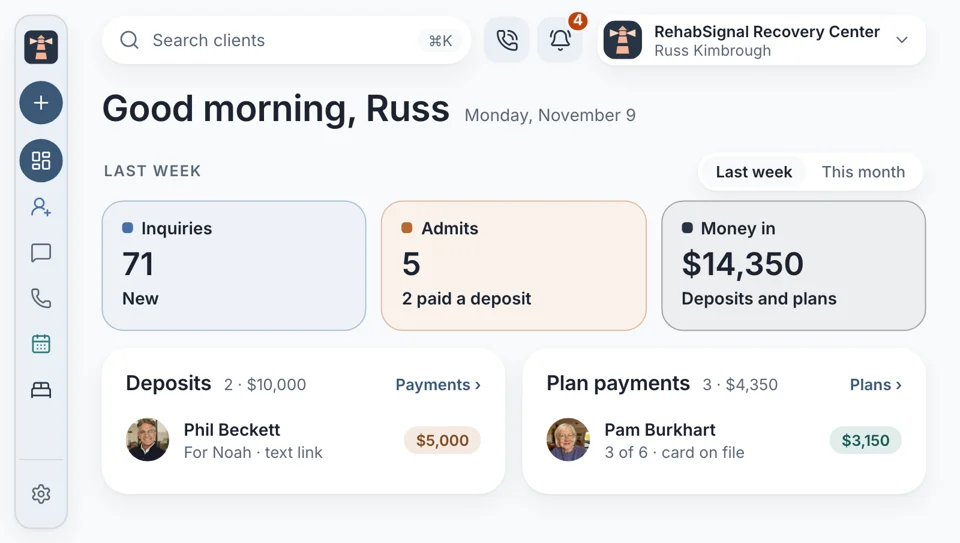
Payments on Monday's dashboard
The owner's dashboard shows deposits and plan payments taken through RehabSignal, so the Monday numbers include money in. Balances your business office tracks elsewhere stay put.
- Monday's dashboard counts deposits paid through RehabSignal last week
- The same screen shows calls, inquiries, admits and reviews too
Screening call
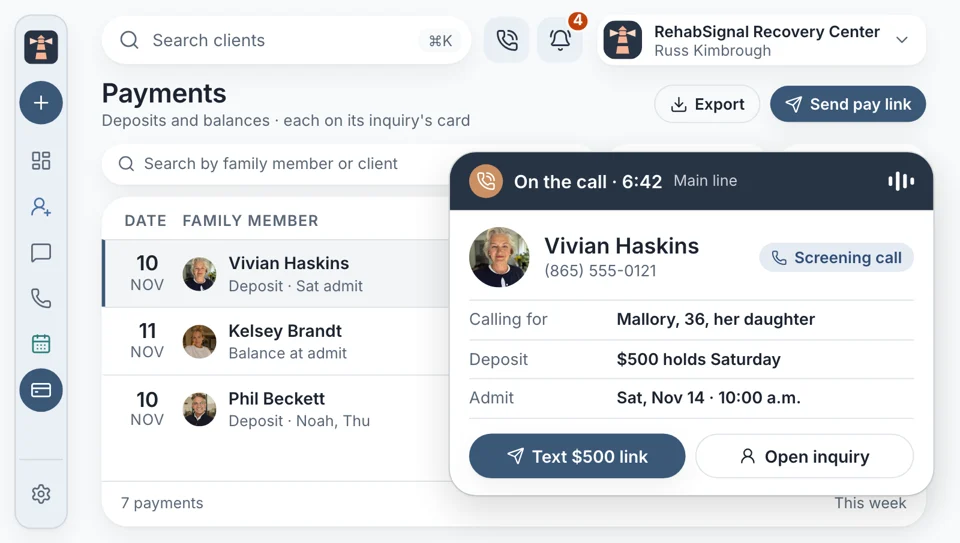
The link before hanging up
The parent says they can pay the deposit today. Your coordinator doesn't take a card number: they tap the pay link on the caller's card while the call is still live, and the text lands before the goodbye. The caller's history stays on screen the whole time.
- Your coordinator sees the caller's history, program and admit date on screen
- The link arrives from the number the family just called
Privacy
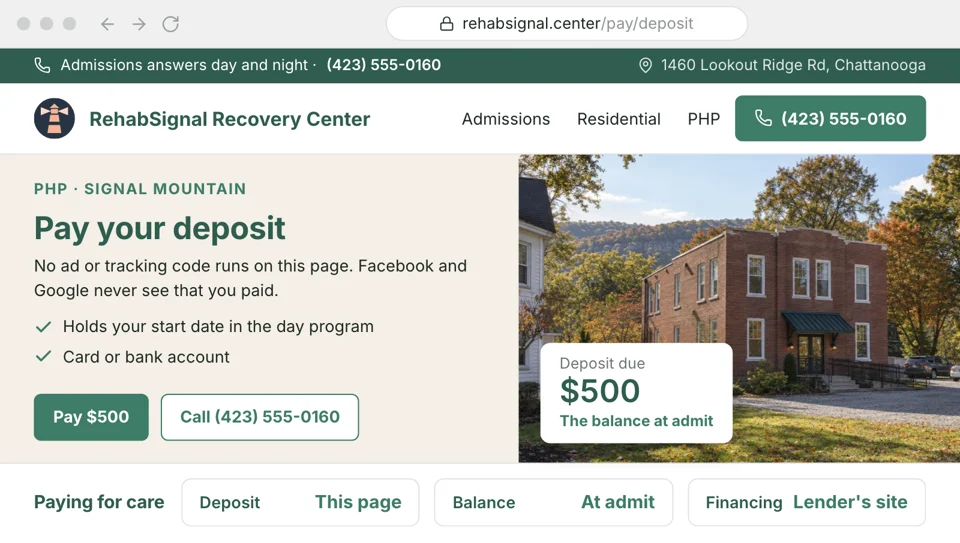
Ads that never see payments
Ads run in your center's own ad accounts once it holds LegitScript certification. Someone who clicked an ad pays on a page carrying no ad pixel. From us, the ad accounts get a neutral event and the time, never a name or a program.
- No ad pixel on the pay page itself, and none on the screen that thanks them after
- Ad networks bill your center directly for its spend
Recordings
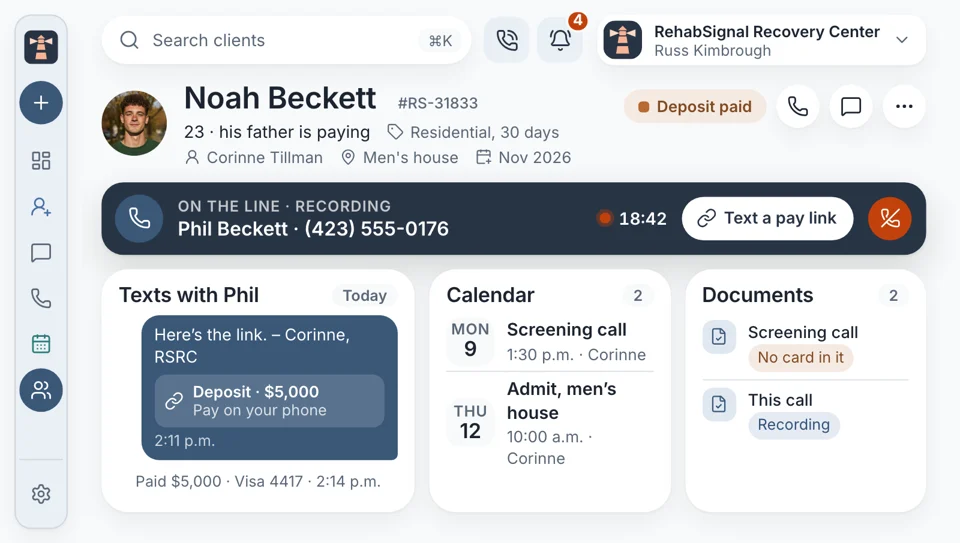
Card numbers stay off recordings
Calls on your admissions line are recorded so screenings can be played back. A card number read aloud ends up in that recording. With a text link, the person paying types the card on their own phone, and the recording keeps the screening without the card.
- The coordinator never hears, types or writes down a card number
- The card goes in on the payer's phone, off the call
Reminders
Reminders two days ahead
Two days before a plan payment, a reminder goes from your center's number, signed with its initials and with no treatment words in the preview. If the date passes unpaid, another text goes out, then an email. An answer to either one goes to your coordinators.
- Reminders stop once it's paid, so nobody gets a wrong one
- Someone asking to move the date reaches your coordinators first
Billing reviews
Answered
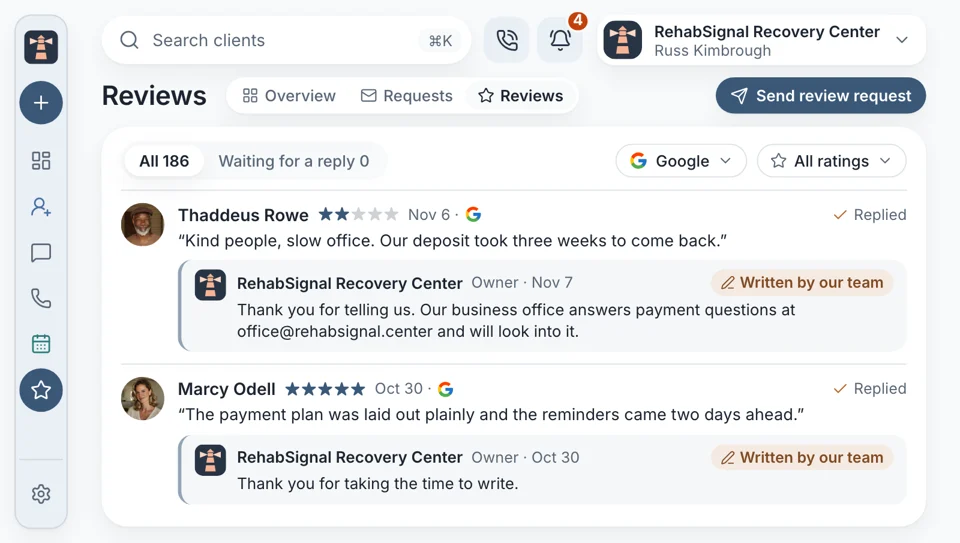
A Google review says a deposit took three weeks to come back. We reply in your center's name, thank the writer, point to your business office's email and never confirm the writer was ever a client.
- Every reply is written from rules your center okayed at setup
- No reply ever confirms that the writer was a client


Also included
- Amounts your team sets
- Saved cards
- Invoices paid online
- Pay links on forms
- Three automatic retries
- Lender links on invoices
Paid, beside the admit date
Open Noah's card and the deposit sits under Thursday's admit: when the link went out, who sent it, when it was paid and the date of the plan's next payment.

Tuesday at 4:12 $500 by Apple Pay, link sent by Rosa, admit Thursday 10:00.
Deposit paidPayments work with
- Phones The screening call that set the deposit sits right above it.
- Website A self-pay page on your center's site carries the same payment link your coordinators text.
- Self-pay search pages We write pages that answer what families search about paying.
- Certified ad accounts Once your center holds LegitScript certification, we run its ads in its own accounts, and the spend goes from your center straight to each ad network.
- Texting Pay links and due-date reminders sit in the same thread as the screening texts.
- Admissions pipeline The deposit and the admit date share the same card.
- Review replies Payment complaints in reviews get our reply in your center's name.
Send your prices and your lender's link
Send your deposit amounts, plan terms and lender's link before the demo. We set them up on a test card and show the exact text a family would get. Pricing goes by staff logins, starting at $97 monthly.


Paid by text

Wendell H.Owner, residential, Asheville Paidbefore arrivalDeposits used to arrive by mailed check, if at all. Now families pay by text before the admit.

Adriana C.Admissions director, Tampa 1 callscreening and depositMy coordinators send the deposit link before they hang up. The family pays on the call, and the bed is set for Thursday.

Felix O.Clinical director, Columbus One threadfor billing questionsPayment questions used to reach my clinicians at family sessions. Now families text the business office and get an answer there.

Colleen J.Alumni coordinator, Knoxville Aheadretreat fees by linkOur alumni retreat used to mean collecting cash at the door. This year everyone paid from a link in the event text.

Devin A.Business development rep, Austin Plain answerfor referring therapistsTherapists ask whether self-pay families can spread the cost. I say yes and show them what the plan text looks like.

Joanna T.CEO, three sites, Denver 3 sitesone deposit textOur three sites took deposits three different ways. Now each one sends the same text and the same link.


Payment questions
Before you send the first pay link
Words to try: deposit, financing, insurance, saved card.
6 questions
Can someone pay deposits by text?
Yes. A coordinator enters the amount on the inquiry's card, and a pay link is texted from your center's number. The person paying checks out by card or phone wallet, and the card shows it as paid. Texts, calls, recordings and forms run in HIPAA mode, under a BAA your center signs with us.
Can we set up payment plans and keep cards on file?
Yes. Your business office splits a self-pay balance into set payments, charged on a card the person paying saved. When a charge fails, the software tries again, three times at most.
Can we send a financing link?
Yes, your own lender's. We collect the link at setup and add it wherever families see a payment: texts, invoices and your site. The family fills in the lender's application on its site, and the approval is the lender's call. RehabSignal doesn't take applications, run credit checks or see approvals, and we have no deal with any lender, so the one you already work with stays yours. If you use two lenders, both links can go in.
Who gets the money we collect?
Your center does. Payments go into your center's own payment account, which we connect during setup, and we never hold the money. Our fee is separate: a flat monthly fee, never priced per lead, per call or per admit.
Does it bill insurance?
No. Insurance stays with your own billers and the software they use today. A photo of an insurance card that a caller texts goes straight to them. RehabSignal takes self-pay deposits, balances and plan payments.
Do payments cost extra?
No. All features on all plans; you pay by the number of staff logins, from $97 a month. Taking payments adds nothing. Month to month, no setup fee, live in 14 days.
Common payment searches
Ask about payments
Megan answers at sales@rehabsignal.com: send your deposit amounts, your plan terms or your lender.
Megan AinsleyAccount manager
Request a demo