

Admissions pipeline for addiction treatment
Forty inquiries,
forty next stepsForty inquiries, forty next steps
RehabSignal is an addiction treatment CRM made for admissions teams at US centers: calls, chats, forms and partner referrals each become a card on a board by stage, showing the program asked about, the source, an owner and a callback due.
- Callback tasks with a due time
- Day-before admit texts

Live in 14 daysMonth to month, no setup fee
- Texts from your center's number
- No-show admit follow-up
- Deposit links sent by text
- Callback tasks with due times
- Pre-admission forms by text
- HIPAA mode, signed BAA
Last week brought 40 inquiries. Twelve booked an assessment and five admitted. The other 28 got one call and a voicemail, and nobody called again on day three. On the board, each of them keeps an owner and a due time.
Kept on sticky notes
Each card, an owner, a due time
A text back, a form, a time


Where cards come from
Inquiries reach the board three ways
Each one arrives with its source.


Ringing a tracking number makes a card before the call ends, with the ad, page or partner behind that number already set as the source.
A web form or chat at 11:15 p.m. creates the card and rings the on-call phone at once. When a coordinator answers, the person who wrote in is connected. Facebook inquiry forms arrive the same way.
When an ER social worker calls the partner line you gave that hospital, the card opens with the partner already named.
Past the first call
Between the screening and admit day
From your center's website
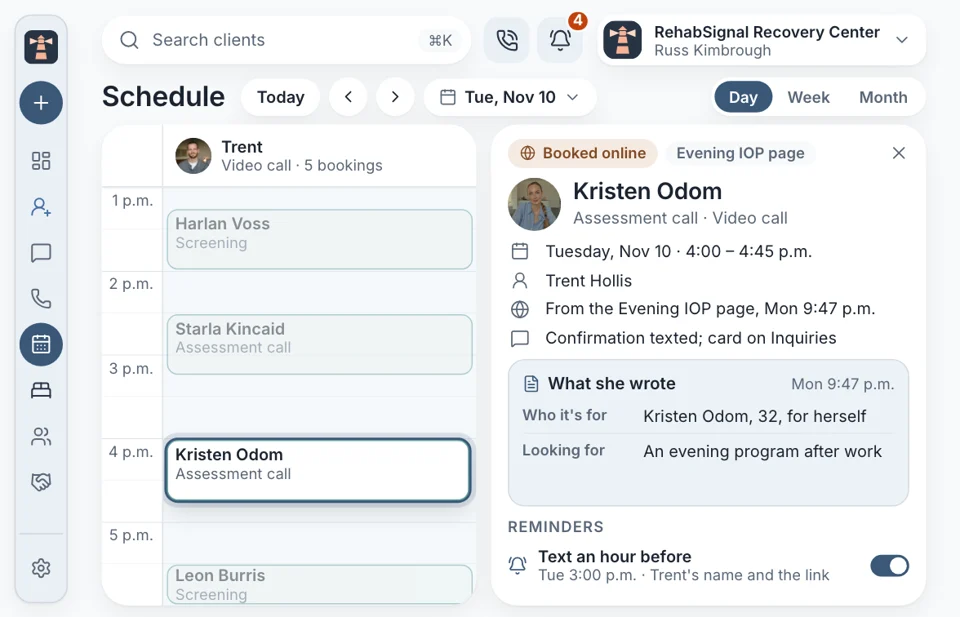
Assessment requests booked from your site
Many families read the site late at night, long before anyone phones. Each program page we build carries an assessment request and a booking calendar. The request lands as a card, and a confirmation text goes out.
- The detox page's form marks the card as a detox inquiry
- The booking calendar shows only the times your admissions team holds open
Callback tasks
Callbacks with due times
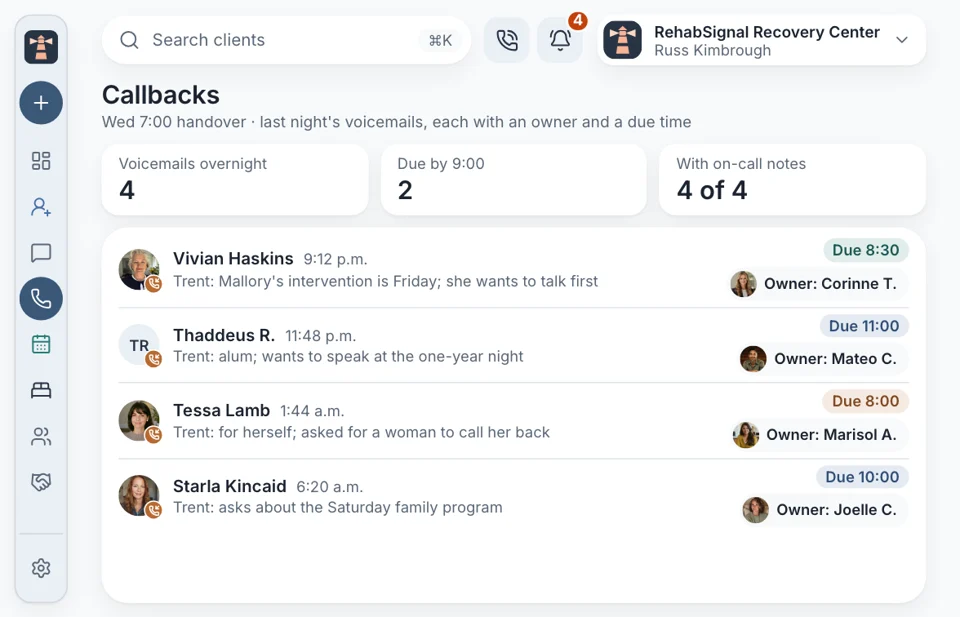
At the 7:00 handover, the night's calls are already on the board. Each voicemail carries a callback task, an owner and a due time, and the on-call coordinator's notes sit on the card. The day coordinator opens the list and sees which callbacks are still open.
- Each task's owner gets reminded when the due time comes
- The admissions director sees each overdue callback and who it belongs to
Inquiries who didn't admit
Texts on day 3, 7 and 14
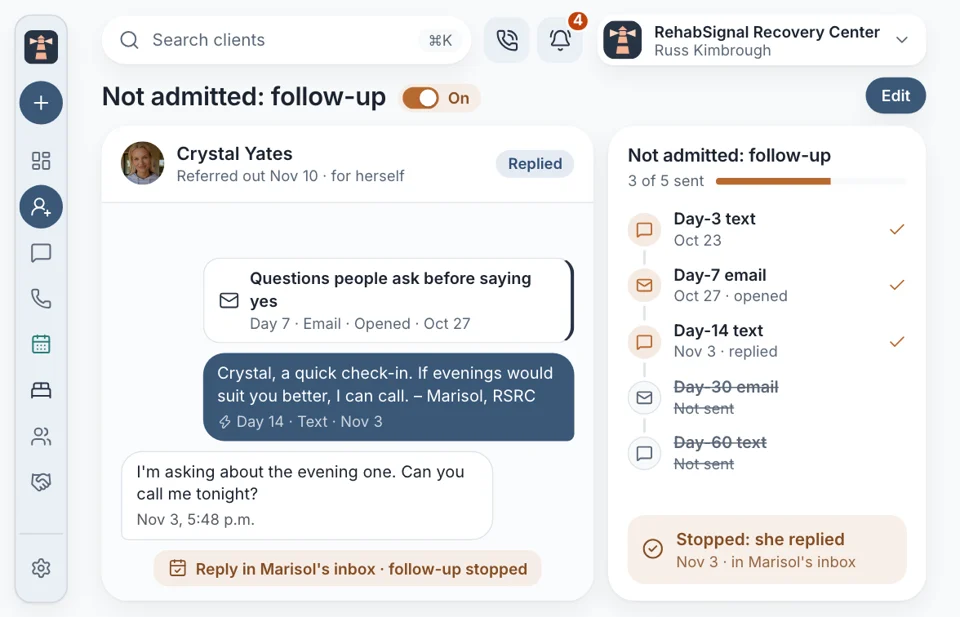
Last week's 28 heard from your center once. Mark a card Not admitted, and if the person ticked the consent box, spaced texts and emails start from your center's number. They stop the moment a reply comes in, and that reply shows up in the inbox your admissions team works.
- No text mentions detox, treatment or rehab; each is signed with initials
- Only people who ticked the consent box get the series, and it stops on reply
Census count
Census count for the morning meeting
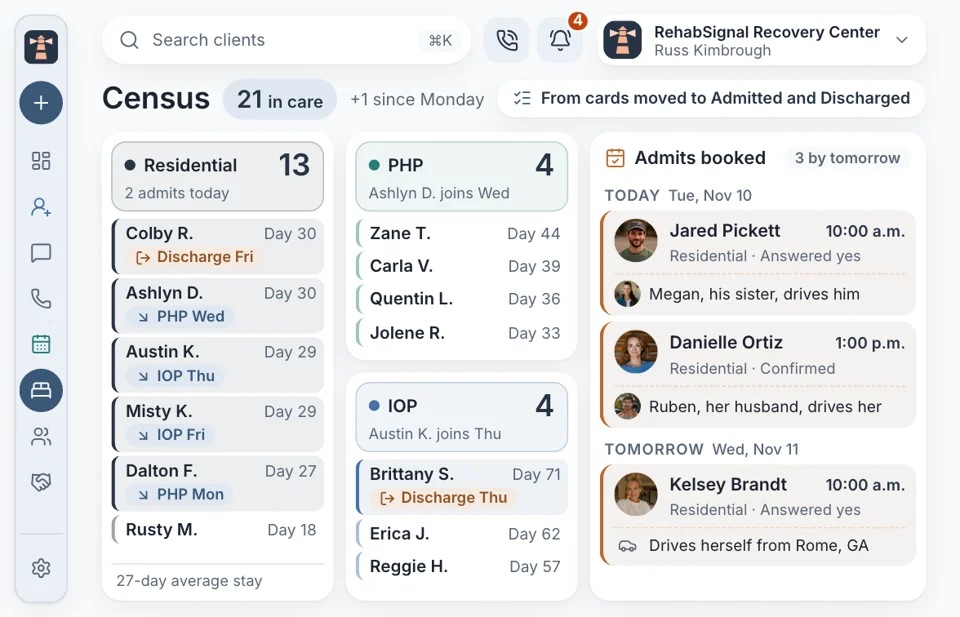
At 8:15 the dashboard shows 21 clients in the Admitted stage and three admits booked for the next two days. The count comes from the cards your admissions team moves to Admitted and Discharged the same day.
- Upcoming admits by date, each with its level of care
- Move a card to Discharged and it goes on to the alumni coordinator's list


Also included
- Assessment booking calendars
- Callback reminders for each owner
- Inquiry and alumni lists imported
- Admit export files
- One timeline for each person
- A separate board for referral partners
Each inquiry, its whole history
When a parent calls back about residential, the card opens with the call: the first form, each call and text since, the program asked about, the source and the next step's owner.

Admit, Thursday Thursday 10:00, residential, day-before text set for 3:00.
Admit scheduledThe pipeline feeds
- Admits by their source Inquiries, assessments and admits by ad, page and partner, plus the inquiry-to-admit rate.
- Call tracking A number per ad and partner sets each card's source.
- Google Maps listing We look after your Google listing, so a call from Maps reaches the board with its source.
- Center website Every program page we write ends on an assessment request.
- Ads Meta, Google and Microsoft ads in your center's own accounts, once certified, each pointing inquiries to the page for its program.
- Spaced follow-ups Texts and emails to inquiries who consented, stopping on reply.
- Review requests After discharge, alumni and families who opted in are sent a review link, never during care.
Bring your spreadsheet
Send the spreadsheet or the whiteboard photo you track inquiries on. On the demo we build your stages and programs from it, and show the board your coordinators would work, from $97 a month.


Called back by day three

Wendell H.Owner, residential, Asheville Mondaysnumbers in handEvery Monday I open the board and see last week's inquiries, assessments and admits, each with its source, without asking anyone.

Adriana C.Admissions director, Tampa Day 3follow-up textsThe 28 one-call inquiries were our gap. Now each voicemail gets a callback task with a due time, and the day-three text goes out to everyone who consented.

Felix O.Clinical director, Columbus Readyon admit dayWhen a card moves to Admitted, the signed forms and the export are ready for our records lead.

Colleen J.Alumni coordinator, Knoxville Same dayalumni hand-offDischarged cards come to my Alumni list the same day, so the first milestone text never depends on someone remembering.

Devin A.Business development rep, Austin Namedhospital on the cardAn ER social worker's referral shows up as a card with the hospital named, and I can see whether it admitted.

Joanna T.CEO, three sites, Denver 3 boardsthe same seven stagesThree sites, three boards, the same stages. I compare inquiry-to-admit rates on one screen.


Questions asked
Asked by admissions directors
Words to try: EMR, census, spreadsheet.
6 questions
What does an admissions CRM track for a rehab?
What admissions runs on: the program asked about, the referring partner, assessment and admit dates, and the census count.
What's the difference from our EMR?
Your EMR keeps the chart, medications and billing. RehabSignal holds inquiries through admit day, and each admit is handed over by export.
Should detox and IOP inquiries share a board?
Either works. One board with the program on each card lets the admissions director filter detox from IOP. If separate coordinators run each program, we build a board for each, with the same stages.
What happens to the card after someone admits?
It moves to Admitted and counts in your census count. At discharge it moves to Discharged, then to the alumni coordinator's Alumni list.
Can it replace the spreadsheet we track inquiries in?
Yes. We import the spreadsheet's rows as cards at setup, with each stage, owner and source, inside the monthly fee.
Who calls back an inquiry that doesn't admit right away?
The card's owner. Every card has an owner and a callback due, and inquiries who consented get spaced texts until they reply.
Popular searches
Ask about your board
Megan answers at sales@rehabsignal.com: send your stages, your programs or any setup question.
Megan AinsleyAccount manager
Request a demo